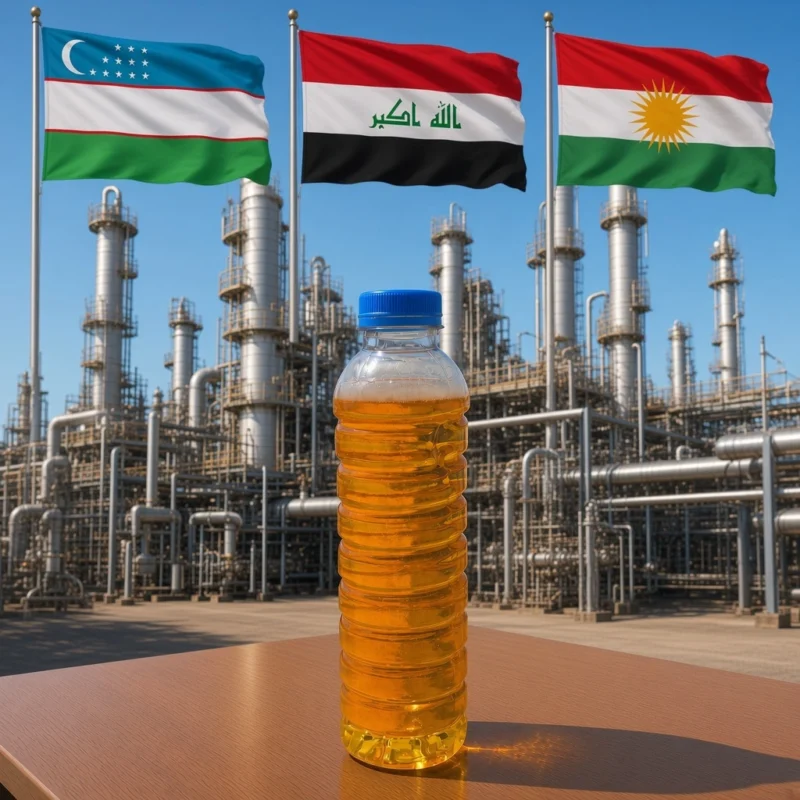
In the Afghan fuel market, diesel combustion quality is one of the most critical factors affecting engine performance. Cetane Number and Cetane Index are the two key parameters that determine fuel quality. Oil Load, a professional diesel producer in the Kurdistan Region of Iraq, manufactures high-quality diesel fuel fully compliant with Afghanistan’s national standards, as verified by official Afghan laboratories.
What is Cetane Number?
Cetane Number is a direct, experimental measure of diesel fuel ignition quality. It indicates the ignition delay — the time between fuel injection and the start of combustion (auto-ignition) in a diesel engine.
- Higher number = shorter delay = smoother and faster combustion.
- It is the opposite of the Octane Number used for gasoline.
- Scale: 0 to 100 (n-cetane = 100).
- Practical range: Good diesel typically falls between 47 and 55. Higher values provide easier cold starts, less engine knock, reduced smoke, and better efficiency.
This parameter is measured using a standardized CFR engine (ASTM D613).
What is Cetane Index?
Cetane Index is a calculated value that estimates the Cetane Number based on the fuel’s physical properties, primarily density and distillation curve (especially the 50% recovery temperature — T50).
- Main standard: ASTM D976 (two-variable equation).
- Advantages: Fast, inexpensive, and repeatable.
- Limitation: It does not account for chemical cetane improver additives.
In many Afghan laboratories, due to equipment limitations, Cetane Index is the primary focus.
Cetane Index Calculation Formula (ASTM D976)
The standard formula is:
CCI = 454.74 − 1641.416 × D + 774.74 × D² − 0.554 × B + 97.803 × (log₁₀ B)²
Where:
- D = Density at 15°C in g/ml
- B = 50% distillation temperature (T50) in °C
Simple Step-by-Step Calculation
- Convert density to g/ml (e.g., 822 kg/m³ = 0.822).
- Calculate D².
- Compute the density part: 454.74 − (1641.416 × D) + (774.74 × D²).
- Take log₁₀(B) and square it.
- Compute the distillation part: −0.554 × B + 97.803 × (log₁₀ B)².
- Add both parts to get CCI.
Oil Load Example (D = 0.822, B = 233): Result = 49.1
Afghanistan National Standards and Cetane Index Range
According to Afghan requirements:
- T50: Minimum 230°C to maximum 280°C
- Density: 820 to 860 kg/m³
Cetane Index Range Table (Calculated per ASTM D976):
| Scenario | T50 (°C) | Density (kg/m³) | Approximate Cetane Index |
|---|---|---|---|
| Min T50 + Min Density | 230 | 820 | 47.8 |
| Min T50 + Max Density | 230 | 860 | 34.2 |
| Max T50 + Min Density | 280 | 820 | 60.3 |
| Max T50 + Max Density | 280 | 860 | 46.7 |
Oil Load Diesel Test Report
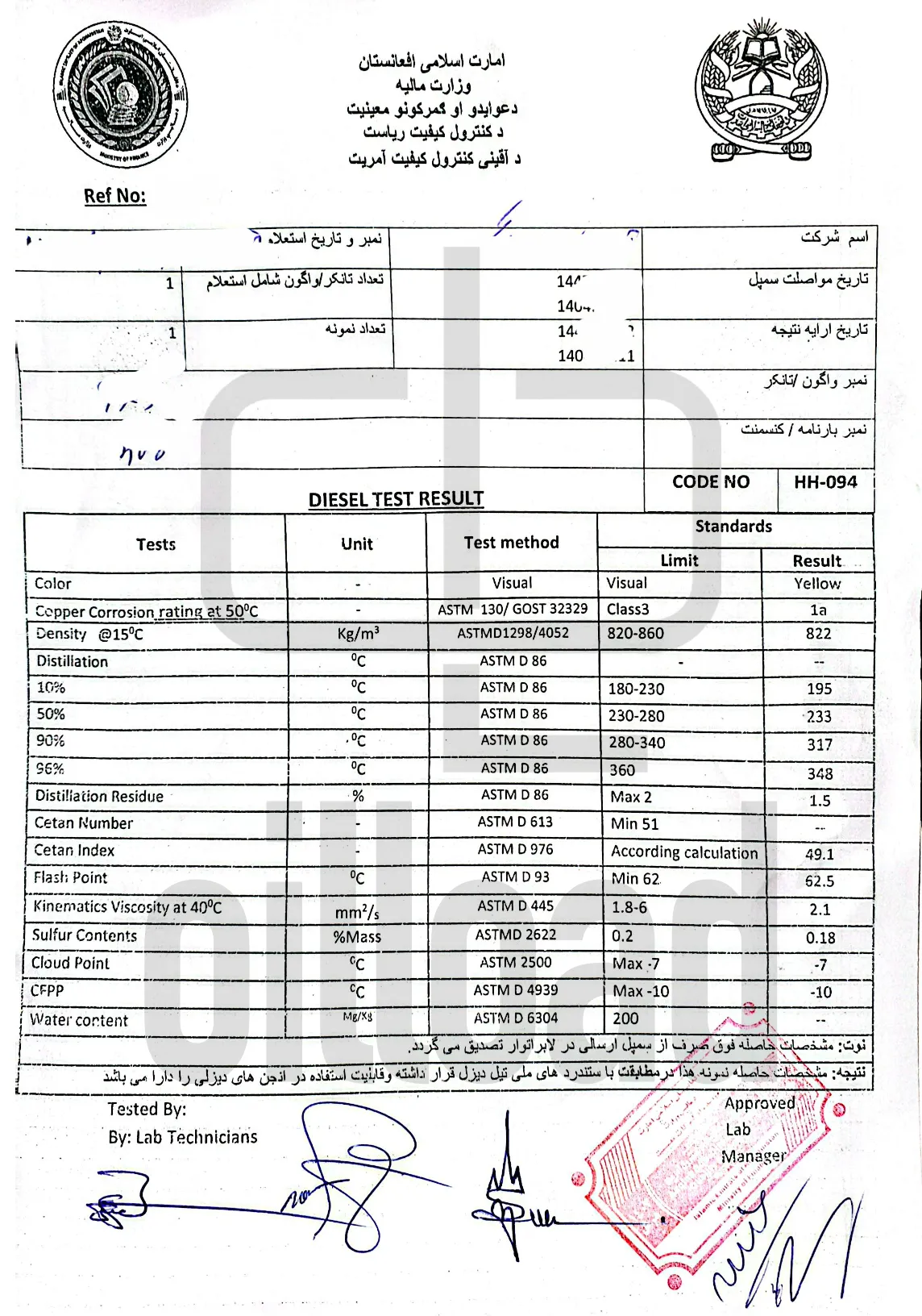
According to the official report from Afghanistan’s Quality Control Laboratory (on oilload diesel cargo):
- Density: 822 kg/m³
- T50: 233°C
- Cetane Index: 49.1
The product fully complies with Afghan standards.
cetane number vs cetane index
Why T50 and Density Limits Exist for Diesel
T50 < 230°C: Fuel becomes too light → engine knock, higher consumption.
Density < 820 kg/m³: Lower energy content, higher consumption, lubrication issues.
Recommended Cetane Level for Afghanistan
- Ideal: 50–55 or higher
- Minimum: 47–49
- Oil Load diesel with 49.1 is in the excellent range.
Oil Load is committed to supplying standard, high-quality diesel to the Afghan market.