


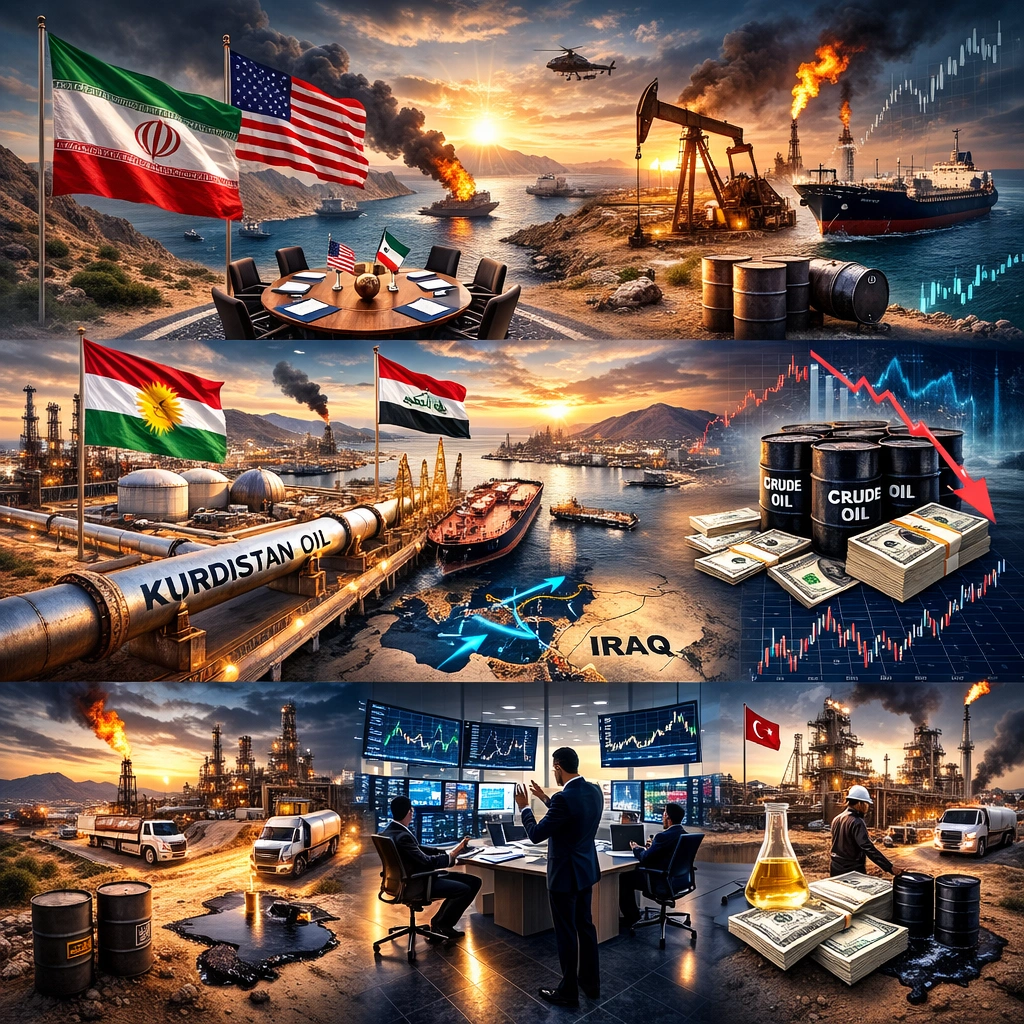
Developments such as declining crude futures due to progress in US-Iran talks, Iranian drills in the Strait of Hormuz, Ukrainian attacks on Russian oil infrastructure, and the Druzhba pipeline outage. These changes are directly relevant to the Middle East and impact Iraq as OPEC's third-largest producer (behind Saudi Arabia and Iran) and the Kurdistan Region as a semi-autonomous area with independent oil production. Iraq produces around 4.5 million barrels per day (b/d), with over 90% of government revenues from oil, while Kurdistan outputs 400-500,000 b/d but faces political-economic challenges like revenue-sharing disputes with Baghdad. In this environment, the Middle East particularly Iraq and the Kurdistan Region of Iraq (KRI) — stands at the center of a new pricing competition. Below, we at oilload analyze the impact of these changes on Iraq and Kurdistan, based on the report's data and global trends.
Middle East: Declining Geopolitical Premium
US–Iran Negotiations
Following the announcement of an agreement on “guiding principles” in Geneva, Brent prices softened toward the $67/b range. This reaction suggests the market is gradually pricing out part of the Gulf war premium.
Regional Implications
Reduced military risk in the Strait of Hormuz
Increased probability of gradual Iranian export recovery
Direct competition with regional sour grades (Iraq, Kuwait, Saudi Arabia)
Even a return of 300–500 kb/d from Iran would place noticeable pressure on Middle East sour differentials.
Impact of US-Iran Talks and Reduced Geopolitical Risk
- Declining Oil Prices: The report indicates progress in talks (agreement on "guiding principles" per Abbas Araghchi) led to lower prices (Brent at $67.42/b, WTI at $62.33/b). This eases the risk premium (estimated 5-10%), potentially dropping prices another 5-7% if talks succeed. For Iraq, whose exports (Basrah Heavy and Medium) mostly pass through the Strait of Hormuz, this stability is beneficial but reduces revenues. Iraq exported about 3.5 million b/d in 2025, and lower prices could widen budget deficits (Iraq's 2026 budget is based on $65/b).
- Impact on Kurdistan: The Kurdistan Region relies on exports via Turkey (Ceyhan port), recently extended for three months. Reduced Iranian tensions could enhance alternative route security, but lower prices pressure Kurdistan's revenues (about 80% of its budget from oil). With 450,000 b/d production, Kurdistan often faces payment delays from Baghdad, and lower prices could deter foreign investment (e.g., Western firms in Taq Taq and Tawke fields).
- Escalation Risk: If talks fail, Hormuz drills could disrupt Iraqi exports (20% of global oil trade through Hormuz), spiking prices to $80+/b and affecting 18-19.5 million b/d regional exports (including Iraq). This is less direct for Kurdistan's Turkey route but impacts global supply chains.
Europe: A More Competitive Arena
Rising exports of WTI to Europe are intensifying competition for light sweet barrels. At the same time:
Libyan supply has stabilized
CPC Blend from Kazakhstan remains active
US WTI Midland arbitrage to Europe is open
The Mediterranean market is currently long.
Result
Softer FOB Mediterranean differentials
Reduced pricing power for Middle Eastern sellers
Heightened competition for European refinery intake
Product Market Shifts: The Dangote Effect
The ramp-up of the Dangote Refinery in Nigeria has significantly reduced gasoline import demand in West Africa.
Implications:
Pressure on gasoline cracks
Reduced export opportunities for Middle Eastern gasoline
Structural weakness in Atlantic Basin gasoline margins
In contrast, diesel cracks remain relatively more resilient.
Strategic Implications for Iraq
Iraq enters 2026 facing three concurrent challenges:
A) Iranian Competition in Asia
Basrah Medium and Basrah Heavy directly compete with Iranian sour grades. If Iranian exports increase:
Iraqi OSPs to Asia may soften
Additional discounts may be required to defend market share
Basrah Heavy is more vulnerable than Basrah Light.
B) Competitive Pressure in Europe
Iraqi light crude remains attractive to Mediterranean refiners, but competition from:
Libyan grades
CPC Blend
US WTI Midland
reduces differential strength.
C) Fiscal Sensitivity
If Brent stabilizes at $65–70/b, Iraq’s fiscal position remains tight but manageable.
Below $62/b, budgetary pressure becomes significantly more pronounced.
Kurdistan Region of Iraq (KRI)
The Kurdistan Region operates under a distinct export and refining structure compared to federal Iraq. This creates both flexibility and vulnerability.
5.1 Crude Exports from KRI
Kurdish crude:
Relatively higher API than Basrah Heavy
Exported via Turkey to the Mediterranean
Key Risks
Mediterranean oversupply
Competition from Libya and CPC Blend
Indirect competition from US WTI
As a result, FOB Ceyhan differentials are likely to remain soft unless a disruption occurs in the Black Sea or Russian flows.
5.2 Mini-Refineries and Product Structure
The KRI hosts a network of mini-refineries primarily producing:
A) Diesel
Supported by:
Strong domestic Iraqi demand
High generator and industrial consumption
Relatively firm global diesel cracks
Gas oil remains the most stable and profitable product in the region.
B) Gasoline
Given:
Reduced West African imports
Pressure on Mediterranean cracks
Intense export competition
Gasoline exports carry higher risk unless directed to domestic Iraqi markets.
C) Naphtha
Naphtha pricing is closely tied to Asian petrochemical demand. Current petrochemical weakness may keep naphtha margins under pressure.
Six-Month Scenarios for Iraq & KRI by oilload
Base Case (Most Likely)
Brent: $65–70/b
Gradual Iranian export return
Softer differentials
Continued but manageable pressure on Iraqi exports
Bullish Case
Security escalation in the Strait of Hormuz
Black Sea disruption
Brent above $75/b
Sour crude premiums strengthen
Bearish Case
Faster-than-expected Iranian and Venezuelan recovery
Brent below $62/b
Heavy fiscal stress in Iraq
Wider spot discounts
Strategic Considerations for Market Participants in KRI by Oilload
✔ Cash Flow Discipline
In a supply-heavy market, inventory holding risk increases. Liquidity management becomes more critical than directional price bets.
✔ Prioritize Gas Oil
Low-sulfur diesel aligned with regional demand offers a more defensible margin profile than gasoline exports.
✔ Sell Into Rallies
Short-term price spikes should be treated as monetization opportunities rather than long-term bullish signals.
✔ Diversify Destination Markets
If Mediterranean margins weaken further, land-based markets such as eastern Turkey, Central Asia, and Afghanistan may offer better netbacks.
Final Assessment
The early-2026 oil market is characterized by:
Reduced geopolitical premium
Rising global supply competition
Moderate demand growth
Softer differentials
For Iraq and the Kurdistan Region, this is not a crisis environment but it is a high-competition, margin-compression phase.
The key variable that could alter this balance remains a security disruption in the Gulf or Black Sea. Absent such an event, disciplined pricing, market diversification, and cash-flow optimization will define successful operators in 2026.

